The tasks of a store manager have become so much more complex than those of a typical retail store owner. Rising labor costs, supplier failures, and very demanding customers all require a lot of work to ensure that everything runs smoothly and that items are available at the lowest possible price. As a result, stores are becoming increasingly stressful to manage.
With thin margins in place for most grocery products, stores aren’t able to absorb waste or inefficiency lightly; the smallest of losses can quickly mount up to serious damage. All aspects of the store’s operation must be effectively managed in order to protect profitability.
The best store managers are consistent in their decisions while also making smart and informed ones. They strive to create habits that lead to wider visibility into store operations, accountability among store staff, and better decision making overall. This means utilizing data to make the best store-level decisions and making the best choices regarding inventory management.

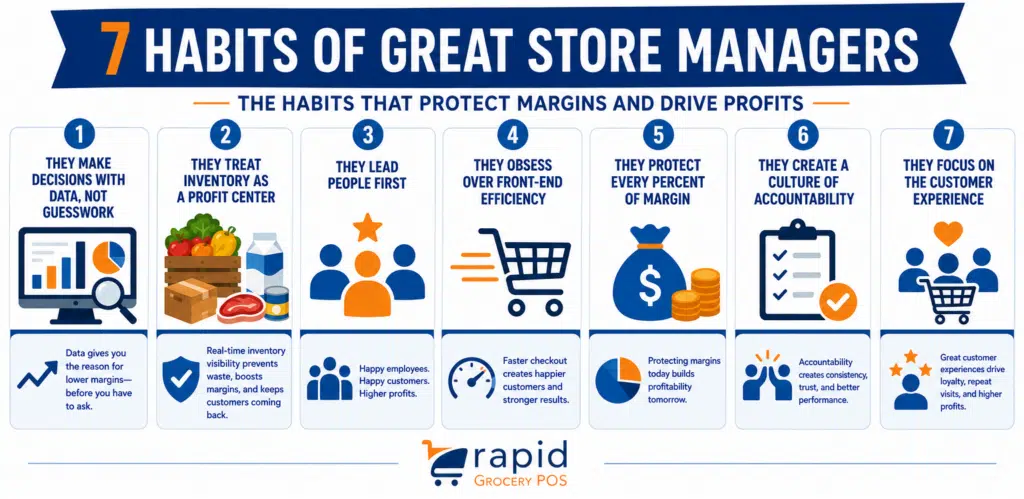
1. They Make Decisions with Data, Not Guesswork
Strong store managers know that assumptions are expensive.
Rather than making store management a purely intuitive task, the most effective managers develop a set of repeatable habits that bring visibility, accountability and good decision making to every aspect of the store. This means using a variety of tools to receive reports and tracking key metrics on a real-time basis using the store’s point of sale system.
Knowing the key performance indicators (KPIs) of a store helps a store manager make better buying decisions, run more successful promotions, create a more efficient work force, and ultimately make the best use of all resources in the store to maximize profits. In short, they can give you the reason for the decreased margins without you having to ask.
A store manager’s job can become easier thanks to real-time reports generated by modern POS systems for grocery stores. These reports contain all of the relevant information of what’s going on in a store and enable the manager to make better purchasing decisions, implement promotions, and successfully schedule employees to ensure the store is running profitably.
2. They Treat Inventory as a Profit Center
Losing the optimal amount of stock is amongst the fastest ways to lose margin.
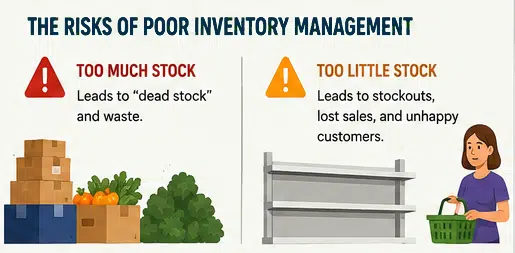
There is a risk of having too much, which then goes down as “dead stock” and also a risk of not having enough, which results in stockouts. Customers then abandon the store and travel to another retailer in order to purchase the products they need. The average retailer loses 4.1% of total sales due to stockouts; it’s very important to maintain an adequate level to keep customers happy and boost margins.
Store managers are able to keep tabs on their entire inventory of products, from the time they arrive at the store until they are sold at the point of sale. This helps them to see which products are flying off the shelves and which are gathering dust in the back of the store.
This is particularly important for grocery stores, which contain a high amount of fresh produce, meat, and dairy products that have a shelf life and must be sold before they expire. In addition, many products in grocery stores are weighed or measured in some way before they are sold to customers (think “bulk items”), which can also add complexity to the store’s inventory.
Managers who are able to track inventory in real-time help prevent waste and keep customer satisfaction high.
3. They Lead People First
Technology matters, but people still run the store.
As the retail grocery industry continues to experience significant labor related challenges, manager’s must begin to consider employee turnover as another cost of labor which is far greater than mere dollars and cents. The turnover of store staff disrupts workflows, in-store training, and vital customer interactions. According to Grocery Dive, retailers reported an average 48% employee turnover rate in 2024, creating constant disruption in staffing, training, and customer service.
Every time an employee leaves a store, not only does it lose the employee, but your store will also be less productive and its customers will beless familiar with the staff.
Top grocery managers use a number of techniques to keep the best employees. By developing the best work schedules, complete training of employees, and adequate communication, many managers find that retaining their employees is more cost effective than having to hire the new candidates in a timely manner.
Managers who focus on their employees first create the best store teams and the best customer experiences (and have the most stable operations).
4. They Obsess Over Front-End Efficiency
Checkout is where customer experience becomes measurable.
Wait times at the checkout line, slow entry of produce into the computer, inaccurate pricing of goods, and slow cash wrapping all can impact customer satisfaction. And while some customers may complain, other customers focus their frustration on the store itself.
As managers analyze the ways in which their store operates at the front end, they keep a close eye on how customers move through the store, how cashiers perform, and how produce is scanned.
From tools to manage weight and look up produce faster, to better organizing the front-end of the store — these processes all help to remove inefficiency at the checkout. Improved checkout speed translates into increased throughput and protects basket size.
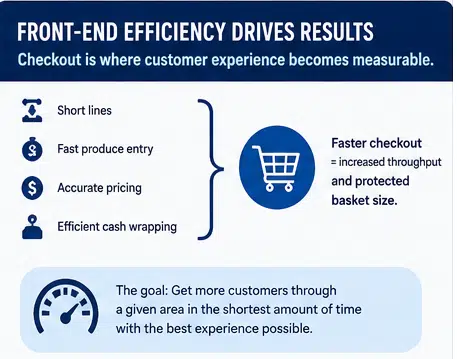
Speeding up the front-end of the store is about getting the greatest number of customers to pass through a given area in the shortest amount of time while providing each customer with a positive experience in the process.
5. They Take Loss Prevention Personally
Shrink or loss is a huge problem in the retail industry today. Many companies treat it as a “cost of doing business” but smart managers and companies know that there is money to be made if they can cut down the rate.
According to the National Retail Federation, shrink averages about 1.6% of sales across all types of retail.
Even the smallest decrease in shrink can increase the profitability of a grocery store.
While some types of loss are worse than others, all negatively affect the store. External theft is bad enough, but loss due to employee mistakes or dishonesty is just as, if not more, problematic. Voids, unauthorized discounts, refunds that were not approved, or pricing that was overridden by a team lead are all examples of types of loss that can be detrimental to a company’s bottom line.
A good store manager is always on the lookout for potential problems that could arise at any time. This is where they’re able to implement various tools and methods to prevent losses. Some of the most effective ways of controlling loss would include implementing secure point-of-sale system permissions, monitoring transactions for any suspicious activity by reviewing detailed reports, and holding his employees accountable.
Shrink should never be accepted as “normal.”
6. They Eliminate Repetitive Work
A store manager’s time is very valuable, yet they still perform a lot of repetitive work.
Tasks like counting inventory, filling out a reorder list by hand, scheduling employees, and monitoring the administrative tasks add up and the manager’s time is absorbed in a sea of mundane activity.
Effective managers automate wherever possible.
Inventory alerts and tools that manage purchasing through existing systems, employee scheduling, and real-time reporting of critical data points can take much of the administrative work out of a manager’s day.
Automation does not replace the manager, it enables them to manage.
Consequently, less time will be spent dealing with problems, and more time will be spent to prevent them.
7. They Think Beyond Today’s Shift
A great store manager is planning for the next 5 years, and when monitoring customer buying trends, evaluating product opportunities and trying to strengthen the store’s competitive position against national chain stores and big-box retailers. First and foremost, strategic growth requires operational clarity.
A connected point of sale allows a store manager to monitor trends and buying behavior of customers to maintain the store’s position in face of competition.
Prepared foods, a strong loyalty program, a good merchandising of the store’s existing selection of fresh products, and technology to manage a store efficiently are ways that a manager can strengthen a store’s overall competitive position.
Managers who have a handle on their store’s numbers today will be able to grow their store tomorrow.
How Rapid Grocery POS Supports the 7 Habits of Highly Successful Grocery Store Managers
Rapid Grocery POS provides independent grocery stores with a solution that helps to manage operations and enables best practices for independent grocery store managers.
Our software is curated specifically for your store and can support large retailers with multiple sites. With a broad range of different features and tools, Rapid Grocery POS offers the support and processes needed to help manage a busy retail store.
Our software supports integrated scales, real time inventory tracking, and over 200+ pre-made reports. Last but not least, there are robust loss prevention tools in Rapid Grocery POS as well, to ensure all cash, products, and even discounts are tracked accurately.
The most effective grocery managers know that building the best processes in their store requires the right tools. The right point of sale system for independent grocery stores is the first step to creating better systems in your store.